Moose Mountain Marathon Training: Week 5

A taper of sorts.

Monday: rest
Tuesday: 5.3 mi, trail (Lakewalk), 132 bpm
Wednesday: 6.7 mi, road, 131 bpm
Thursday: 7.3 mi (4 x 1 mi), paved trail (Munger), 147 bpm
Friday: rest
Saturday: 6.2 mi, trail (SHT @ Becks Rd), 144 bpm
Sunday: 9 mi, paved trail (Lakewalk), 144 bpm
Total: 34.6 mi

Winter is coming. It’s depressing to think about, and the weather is still nice so it’s easy to forget, but it’s looming. The days are shortening, and I’m starting to realize I can’t lollygag around home and still get in a workout before dark. Twice this week I was caught out at dusk with no headlamp and no reflective vest.

Monday I took a rest day because my hips were hurting. I wasn’t especially concerned because both sides hurt and it felt more like muscular soreness than a real injury, but I did not want to take any chances. I don’t really like to take Mondays as rest days, since it means I don’t have flexibility later in the week, but sometimes it’s necessary. I felt much better on Tuesday so clearly it was worth it.

Tuesday & Wednesday: boring runs of no interest.

Thursday I ran 4×1 mile on the Munger Trail and it was hard. My hamstrings did not like it. I felt for awhile like they were on the verge of snapping, like violin strings, when one slight turn of the peg would be too much.
My repeats were:
9:20 @ 175 bpm, 9:30 @ 176 bpm, 9:34 @ 175 bpm, 9:40 @ 173 bpm
I had to slow a bit on the 3rd repeat because I thought I was going to barf up my energy bar, and on the 4th repeat I guess I just got gassed. Strava says I set a mile PR. Hooray I guess.

Friday I had planned to run and didn’t and that was fine. Saturday I did a trail run and bonked like 3 miles in, thanks to some bad timing. I had a gel and felt better but it was still not the best run.

Sunday I ran the Lakewalk from Brighton Beach to Canal Park, which was one of my goals for the season. I didn’t really want to run 14 miles, so I wasn’t sure what to do, then had an epiphany, I could ask my husband to pick me up at the Rose Garden and drive me back to my car. I try hard not to ask him to do stuff like that too often, but the Rose Garden is fairly close to my house (not close enough to run! and all uphill), so it wasn’t a huge burden for him. The Rose Garden/Leif Erikson park is a Pokestop, which meant it was crawling with people not paying attention. Canal Park was also teeming with tourists. I should have known this, and attempted the run anyway, so it’s my own fault.

I managed to do yoga or some other quick strength training almost every day this past week, so I am going to pat myself on the back. I guess the hip soreness scared me into getting my stretches in. Now it’s time to take it easy with a lot of gentle running leading up to the race on Saturday.
Destination Long Runs

This is the first weekend in awhile that I won’t be taking a long drive for a long run. I’m happy about that, both because I am tired of devoting my entire day to a run, and because I don’t like the environmental impact of driving so much to runs. (Also I have a lease on my car right now, and while I’m 99.99% certain I’m going to buy it when the lease ends, I’m way over my mileage so if I did need to turn it in, I’d owe a bunch of money if this trend continues!)

I’ve learned some very basic, obvious lessons about how to make these runs work for me.

  1. Keep a bag packed with the basics.
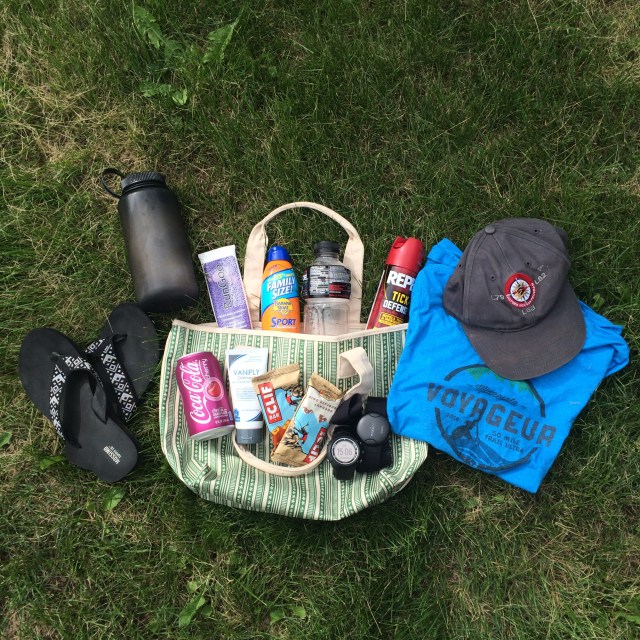
    image1 (4)

    Snacks, water, empty bottle (they don’t sell my favorite Powerade flavor in the smaller bottles, so I just refill this one), bug spray, sunscreen, various lubes, clothes, and my GPS watch/HRM, all in one bag and ready to go. It’s a great use for one of the million gift with purchase bags I have.

    I have a bag packed with pre-run and post-run gear all the time. My hydration pack has more supplies in it (TP, mints, gels, etc.), but the bag of basics I can grab for a long drive or a short one and be ready to go right away. Just like a gym bag. Before, I was keeping some stuff in my car, other stuff in my house, and then trying to remember everything each time. Now my car’s a bit less cluttered and I am not running around confused or forgetting important things when I head out.

  2. Fuel up on the drive.
    So obvious. Eat and drink while driving, rather than eating and drinking before departing. I wouldn’t have to say this if I hadn’t made this mistake before, and ended up hungry/bonking on the run. I drink a vanilla Coke and eat an energy bar on the way up north now.
  3. Keep cold drinks and a snack in the car for afterward.
    I freeze a bottle of water completely solid, and even on warm days when I’m gone for hours, there’s still at least a bit of ice left, and it’s refreshing. Packing a cooler could be a good idea, too, but that’s more work than I’d like. Ideally I’d like a snack afterward that’s different from running food (gels and energy bars), but I’m settling for another energy bar right now. A sandwich would be delicious.
  4. Bring a change of clothes.
    One uncomfortable ride home from Schroeder, MN convinced me of that. I couldn’t even clean my glasses. Now I bring a t-shirt and flip-flops. Bringing a towel to sit on is another option, for people who want to protect their car but don’t care about changing clothes.
  5. Time of run > time of drive
    Sorry, fast people, this puts you at a disadvantage. However, a 3 hour round trip for a 2 hour run is environmentally irresponsible and hardly seems worth the effort, besides.

These are all very simple changes, hardly ground-breaking epiphanies, yet they’ve made long run travels a lot easier.

Moose Mountain Marathon Training: Week 4

My last big week before the race!

Monday: 6.2 mi, trail (Western Waterfront trail), 134 bpm
Tuesday: 5.4 mi, trail (SHT starting @ Magney), 151 bpm
Wednesday: rest (yoga)
Thursday: 7.3 mi (8 x 0.5 mi), paved trail (Munger), 143 bpm
Friday: 5.7 mi, paved trail (Lakewalk), 126 bpm
Saturday: 14.4 mi, trail (SHT @ Lutsen), 144 bpm
Sunday: 5.5 mi, paved trail (Bong Bridge), 130 bpm
Total: 44.4 mi

Last week was an eventful week. Monday, I found a new trail, the Western Waterfront trail. It is accessible from the Munger trail near the Munger Inn. It’s not a really long trail, but I wasn’t able to traverse the entire trail due to construction. This gravel trail follows the St. Louis River in west Duluth, with nice views and very little traffic, at least when I was on it. I will have to give the entire trail a shot some time, once I’m confident the construction work has passed by.

Tuesday, in addition to running, I did some trail work on the Superior Hiking Trail. I was able to sign up through an event at my work, so I can’t really call it volunteering, as I got paid. We assisted with a trail re-route near Keene Creek, including moving a small footbridge (the one that crosses the creek right before the trail goes under the freeway). I got to meet Larry, who is responsible for trail maintenance on the Duluth sections of the SHT, and give him a big thank you for the great trail conditions. I used a glorified rake called a MacLeod (?) to do final grading of a section of the trail, and removed roots and weeds from the trail. I was planning on running right after we completed the work, but it was 88F so I went and got an iced latte and cooled down for awhile before running in the late afternoon instead.

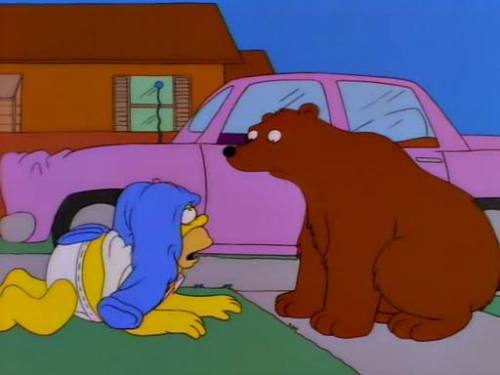
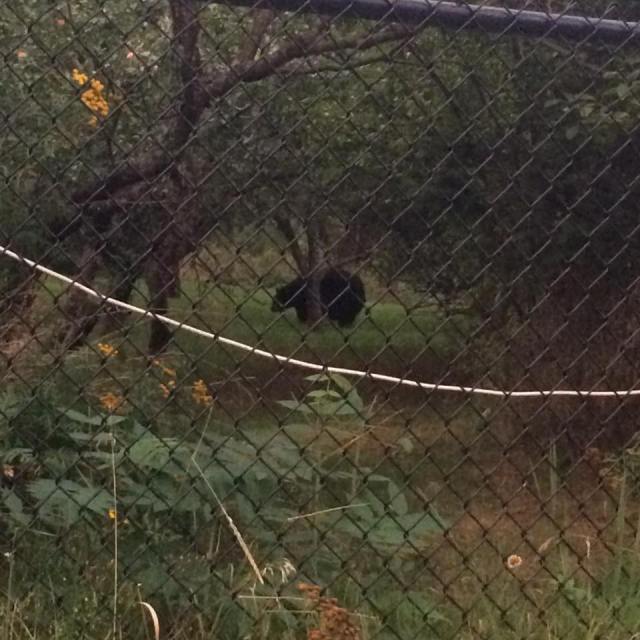
Thursday’s speed workout left me with horribly tight hamstrings both Friday and Saturday. Each day, it took a couple miles to loosen them up. Friday I went running on the Lakewalk and saw a bear. That was exciting. There was a chain link fence between the bear and me, but the fence wasn’t actually containing the bear. S/he was just chowing down near Tischer Creek. At first I thought it was a large dog, then backtracked realizing, no, that’s not a dog.

bear jamboroo

It’s a freaking Country Bear Jamboroo on the Lakewalk.

I’ve spent hours and hours running alone in the wilderness but I see a bear on a well-traveled paved trail in the city. Of course.

Saturday I trekked back up to Lutsen to finish my recon of the marathon course. All I had left to do was the Oberg to finish section, which I’ve already done as it is the Superior 25K course. And oh yeah, it sucked last time. I found it challenging this time around, but not nearly as difficult as I did back in May. I was able to scale Moose Mountain and Mystery Mountain without stopping (though Moose Mountain was still incredibly tough), although I know when I’ve got 20+ miles on my legs, it’s going to be a lot harder. I can attribute my improved ability on the course to a couple of factors: 1. Improved fitness (I think) 2. Better weather (cooler in August than in May, that is odd) 3. Managed expectations (I knew that Mystery Mountain would go on forever, so I was mentally prepared). The first few miles of the run were tough due to my tight hamstrings. I had to pick around a lot of rocks and roots and didn’t have the maneuverability I’d have like. I had to stop a couple of times to practice my latrine-digging skills, so that was a bit annoying, but that was only due to poor planning/timing, not stomach issues. I encountered a group of ladies hiking on the trail, hearing them before I saw them as one was wearing bells to scare off wildlife (I assume). Jokes on you, lady: all the bears are in Duluth.

Sunday my hips hurt, so I didn’t push too hard on my recovery run. I ran across the Bong Bridge from Duluth to Superior (and then back again), which was cool, but not as cool as I’d have liked.

It is a short run; the bridge is probably less than 2 miles across. I thought at some point the view would be breathtaking, but I never quite got my socks knocked off. I don’t plan to run this route often, but I wanted to give it a try at least once.

This was probably one of the most interesting training weeks I’ve had, with something notable happening every single day (new trail, wildlife encounters, trail work). I am pleased I’ve been enjoying running again lately; it means the break I took in July to get my head straight was worth the time off training. Never dismiss the power of a mental health break.

And Now For Something Completely Different

I have gotten really sick of slogging up and down the ski hill at Chester Bowl, and decided my speed work for this week would be… actual speed work. The last time I did something like that was 2 months ago, on the treadmill.

Naturally a good way to start doing speed work again is to do something really hard. Like 8 x 0.5 mile with 0.1 mi recovery. I probably need a coach or I’m going to hurt myself at some point. It was a bit reckless to do something very different from the slow trail runs I’ve been doing.

I drove to the Munger Trail in west Duluth for this workout, which is my new favorite spot for flat (well, flat-ish) running. There are of course slight uphills and downhills, and some gravel spots, but it’s no Superior Hiking Trail.

My warm-up was about 1.2 miles (it was going to be 1 mile, but I’d have had to start my first interval right before a street crossing), and I could tell that my legs weren’t interested in running fast. I warmed up slowly, in fact I walked the first tenth of a mile or so, but I couldn’t ramp up. My legs were heavy and slow, like stumps. I dove in anyway.

Rep 1: 9:38 pace, 170 bpm
Uhhh. No. The first 4 reps were at a slight incline, but I felt like I was wearing weights on my legs. They would not turn over.

Rep 2: 9:20 pace, 150 bpm
I had a HRM issue, not a miraculous improvement in aerobic function.

Rep 3: 9:06 pace, 110 bpm
Obviously another HRM problem.

Rep 4: 9:16 pace, 177 bpm
Rep 5: 8:50 pace, 169 bpm
I turned around after rep 4, so this one was slightly downhill

Rep 6: 9:01 pace, 174 bpm
Rep 7: 8:53 pace, 172 bpm
Rep 8: 8:59 pace, 174 bpm

This was tough. My recovery between each interval was about 2 minutes, which was about how long it took to get my heart rate under my aerobic threshold of 142 bpm. My legs didn’t feel recovered in that time, but my cardiovascular system kind of did. Not entirely, but enough that I didn’t extend a single rest period. I did find that I needed to really slow down, since I was basing my recovery on distance rather than time (just to make it easy to start/stop intervals based on my watch display).

I looked at my watch A LOT during this workout. I tried not to look at the distance, only the pace, to make sure I was really keeping up the speed I wanted to (low 9:00s or high 8:00s) and wasn’t going TOO fast. During my 6th interval, for a few seconds, I was in the 11:00s! And during my 7th interval, at the beginning, I hit 6:53 for an instant. All over the map.

My hamstrings felt pretty taut after I completed the intervals, and I made sure to walk my 0.1 mi recovery before doing my slow cooldown run. I ended up walking again even after starting my cooldown, because I felt like I was on the verge of a muscle cramp. I was glad for the long cooldown, because by the end I felt almost normal. Today I have some soreness on the backs of my legs, but nothing major.

Now I want to race a 5K and see how that goes. Next week I may do some mile repeats (4×1 maybe) with one really going all out to see if I can set a Strava PR. Overall, the paces were faster than I expected and maybe faster than I should have run them, given that my current PB in a 5K is a 9:37 pace. However, my HR in that race was 183 bpm, whereas my average HR (for the intervals that didn’t have a glaring error) was around 10 bpm lower. I was exceeding 5K pace, but staying below 5K heart rate. Since my PRs are all still “soft” I think going off HR is going to be more informative.

I’ll see how Superior goes and then snoop around for a 5K in the area a few weeks later, to see if I can get that sub-30.

Moose Mountain Marathon Training: Week 3

The week ended not with a bang, but a whimper. However, overall it was a good week.

Monday: 7 mi, road, 138 bpm
Tuesday: 6.3 mi, trail (SHT starting @ Highland/Getchell), 144 bpm
Wednesday: 5 mi, road/trail (including 8x Chester Bowl ski hill), 146 bpm
Thursday: rest (yoga)
Friday: 20.4 mi, trail (SHT, Sawbill to Temperance to Oberg to Sawbill), 152 bpm
Saturday: rest
Sunday: rest
Total: 38.8 mi

I had a great week of running, capped off by a weekend of doing nothing. I had planned for Saturday to be a rest day, as I was heading down to the Twin Cities overnight, but I had also planned on running Sunday after returning to Duluth. I didn’t. Oh well.

Friday’s run was VERY important. I was pretty nervous about the section of the course I ran, starting from Sawbill and heading back to Temperance River where I turned around last week, then ran through Sawbill (stopping at my car to throw some stuff away and refill my sports drink bottle) to the Oberg parking lot, then turned around and went back to Sawbill.

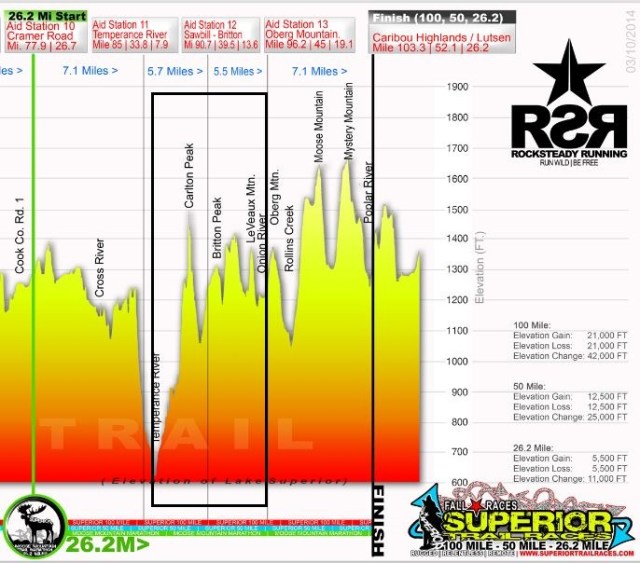
The profile looks a little scary.

MMM4

Yeah, that climb out of Temperance scared me. But it wasn’t really that bad! Carlton Peak gets fairly technical at the top, but it isn’t a straight up climb, and none of the climbs are too frightening. (Photo from the race website.)MMM3

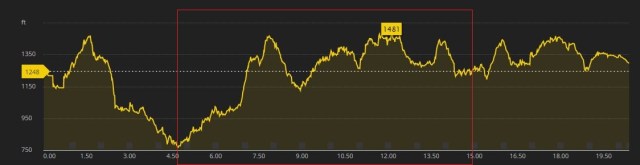
Here’s what the elevation profile looks like from my GPS data. MUCH more manageable, no?

I ate a lot more during this run. I had 2 protein bars, 4 gels, and about 32 oz of sports drink. I didn’t feel like I truly bonked during this run, like I did last time, and I didn’t have any horrible, frustrating rage. Man shall not live on gels alone, I learned. I think I have a good idea of what I need to carry with me during the race, and I’ll supplement by stuffing my face at aid stations as I am able.

I’m starting to get excited for the race, and almost maybe a little bit confident, or at least much less pessimistic. I’ve got food, clothing, and gear nailed down already, and I’ve got one more date with the course (and my friend Moose Mountain) this Saturday. Less than 3 weeks to go!

Moose Mountain Marathon Training: Week 2

I’m living in denial. This marathon isn’t less than a month away. Everything’s fine.

Monday: 5.1 mi, road, 142 bpm
Tuesday: 7.2 mi, trail (SHT starting @ Twin Ponds), 157 bpm
Wednesday: 5.2 mi, road/trail (including 7x Chester Bowl ski hill), 152 bpm
Thursday: rest (30 min of yoga)
Friday: 5.2 mi, paved trail (Lakewalk), 141 bpm + 20 mins of yoga
Saturday: 15.9 mi, trail (SHT @ Cramer Rd), 155 bpm
Sunday: 5.2 mi, road, 135 bpm
Total: 43.7 mi

Definitely a quality week of workouts. But also a reminder that I don’t feel very ready for a marathon.

One notable stat to mention is my average heart rate on these runs. Half of them have average heart rates over the target of 143 bpm I had when I was doing MAF training. I’m not sure if this is good or bad. It’s freeing, not being tethered to that monitor and obsessing over staying aerobic. But now I’m in a sort of no-woman’s-land, with some aerobic workouts, some that are mostly aerobic, and some spots where I’m hitting my max heart rate (or thereabouts). It’s probably not good to hit my max heart rate on a long run. But what am I supposed to do when there’s a huge steep hill to climb? Climb it, heart rate be damned.

I was fairly pleased with my run on Tuesday. It was HOT when I started, although I waited til about 6:15 pm to start, so I didn’t have the blazing sun on me. I managed a much faster pace than I normally do for trail training runs, even on the steep climb I hit after leaving the Lincoln Park area. Between that run and my hill workout the next night, I was feeling pretty confident about my training.

Saturday I ran the first ~8 miles of the Moose Mountain Marathon course. I’ll have some details on that run later, but I made some key observations during this run. First, even with all the climbing I’ve been doing, I’m still not in super great shape for the big climbs. I really struggled on the way up from the Temperance River after I turned around, and I know that the climb out of the river is even harder in the opposite direction, since it crests Carlton Peak. I am nervous about that. I was swearing and getting frustrated during miles 10-12 on Saturday. I think I can also attribute that to poor nutrition. I need to be better about timing my food so that I’ve got energy during a climb. I pulled myself together once after those few low miles, but I was really, REALLY cranky for awhile. And also very nervous, because of the challenges that will face me on the course next month. I guess I need to constantly stuff my face with food while running.

Sunday I was a little bit sore in the quads and stiff in general, and I lacked energy on my recovery run. Not surprising. After my run I had to sit in the car for an hour and a half to drive back, not an ideal situation. I got home from Sunday’s run just as the men’s 400m finals began, so I got to see Wayde van Nienkirk’s amazing race. Perfect timing.

Somewhere on Sunday, while I was cursing and grumbling, I surpassed 1000 miles for the year. I’m less than 200 miles from surpassing my total miles for 2015, so I’m on track for this to be my biggest year yet!

Process-Based Goals

In my previous post, I wrote about my focus for the rest of my Moose Mountain Marathon training: to run in a more engaged way, instead of settling back and running a too-slow pace because it feels “easy.” Running “engaged” to me doesn’t mean running hard all the time. Like I said, I’ve found many times that I thought I was running at a decent clip, only to look down and see I’m running a 19 or 20 minute pace (on trails). I’ve found that by altering my form, I can run faster while still maintaining an aerobic heart rate (if that’s the plan for the workout), but I tend to settle into a form that lends itself to slower-paced running, when I’m not engaged.

Then on Tuesday, I read an article on I Run Far by Joe Uhan about setting process goals rather than outcome goals. It sounded exactly like what I was talking about.

“A process goal is a subjective, qualitative measure of how something is done, rather than how much or how fast. Examples of process goals might include how a run feels (the goal to ‘find ease’) or how the body moves (biomechanical goals such as ‘quick feet, strong arms, and forward lean’). Sometimes the processes are analog: ‘go run’ or ‘go to sleep now.’ But built into each process goal is both an execution–do or do not–and a feel.”

In my first paragraph I described a biomechanical process goal without realizing I was. People set process goals for races a lot, without realizing it. Usually those process goals are “finish smiling” or “finish strong” or something similar. However, those process goals are often B or C or Z goals, with an outcome-based A goal (finish under X hours, set a PR, finish in the top 10/top 3/etc.). And the process goals aren’t taken as seriously, or are there as an afterthought but would be considered a failure. I mean, would anyone ever set a goal of finishing, say, a 100 mile race under 24 hours, and then be happy with a 36:59:59 finish as long as they were smiling? Probably not unless they had some kind of beatific transformation while out on the trails. Which we all do, don’t we? But not to that extent.

I don’t know if I can ever really eliminate outcome-based goals from my running strategies. I like focusing on hitting times. I don’t worry too much about placing because it’s unrealistic for me. I like to see how my placing has improved in 5Ks, but that has as much to do with the makeup of the race entrants as it does about my abilities as a runner. I also like the certainty of knowing I hit those goals. How do I know if I’ve achieved a process-based goal? It’s a feeling. Yesterday, I ran 7 miles on the Superior Hiking Trail, starting at Twin Ponds and running toward Enger/Piedmont/out that general way. It was pretty hot, probably still in the high 80s F, when I started, and I felt a bit funky for the first mile or two, but I really tried to stay engaged on the flats, downhills, and gentle uphills. I ended up with a much better pace than the last time I’d run a similar course, and a much better pace than I normally hit on Superior Hiking Trail runs. Granted, I also had a much higher average heart rate than I have had on some of those runs, but it was hot and I was also powering up the hills. There were also times when I did notice myself settling in or running lazily. And there were times when I wasn’t letting my heart rate recover enough and should have slowed down, but continued to push. So does that mean I made my goal or not? I felt like I did. So I did. Participation trophy, please.

I’m interested in seeing what else I can learn from the rest of the columns on this topic (the article was part 1 of I think 3?), and how my training and racing will be affected by what I discover.