Zumbro Kick-Off

Yesterday was the beginning of my 12-week training cycle for Zumbro 17. I am pretty excited! It feels nice to be training for something again. I put in a decent base-building month or so, averaging 29 miles/week over 5 weeks.

Surprisingly, there aren’t a lot of 17 mile racing plans out there! It’s unfathomable that this uber-popular distance would get such little attention. I created my own plan, starting with the Hal Higdon intermediate half marathon plan, but making some minor alterations.

I’m still moving ahead with MAF training. My hope is that I will see some real improvement with this training once the weather is milder. I need to be patient. The only speedwork I’ll be doing is hill work, and I’ll be sticking to the same max heart rate goal.

For strength training, I am trying to do the Myrtl routine at least a few times a week. It has really helped the funny little twinge I get in my hip from time to time. I’m going to try to mix in yoga, push-ups, and planks when I can, but make the Myrtl exercises my priority.

I need to make some dietary changes, but I haven’t quite decided what to do yet. I need to muster up the energy to plan and pre-make lunches, to start. Since I am working full-time now, rather than juggling school and work, I have more of a routine, but I’m also a lazy eater, I just eat what’s convenient. I don’t see that changing too much all at once.

I have two vacations planned during the training cycle: a five-day trip to Florida at the end of February, and a four-day trip down to the Twin Cities for the NCHC hockey tournament mid-March. I plan to make those both cutback weeks and go with the flow. My family doesn’t need to wait around while I run for 4 hours. I also don’t want to run for 4 hours in Florida; I won’t be acclimated.

Speaking of the weather, today is the last really awful cold day in the forecast, so I’m looking forward to getting outside to do some runs later in the week. I’ll be back to double-digit runs in a few weeks, so I need the nicer weather to continue!

Snow Falling Sideways

Wednesday I took a rest day, as it was as good a day as any, plus I was tired. I felt a bit like I was coming down with a cold. I felt pretty crummy yesterday morning, too, and was thinking of taking a second rest day. I perked up as the day went on, but I thought I’d play it safe and slog it on the treadmill. It was warmer but it was snowing and windy and I thought I might get too chilled.

I got home, farted around on Facebook for awhile, and a friend of mine posted this article about running outside in winter. It’s nothing ground-breaking, just a woman writing about why she likes it, but it was enough to get me out the door. I’ve been grousing about the cold, complaining about the treadmill, and wishing to get outside, I couldn’t squander the opportunity.

Even when it was snowing sideways on the Lakewalk. The wind was pretty rough at first, and snow had blown over the trail for the first half mile. I wasn’t sure if I had made a very good decision, especially when I was facing the wind head-on in the second mile.

Once I turned around and headed back, I was glad I’d done it. Ice floated on the water, bobbing on the waves as they crashed into the shore. The clouds over the city gave way to black sky over the open water. I had the path mostly to myself, although there were a few other intrepid runners and walkers enjoying the warm-up while it lasts.

My actual running plans are fairly boring. I run 4-6 miles or so most days, at my max heart rate. That’s it. Nothing notable.

The lottery for the Superior 25K ended last night, so fingers crossed I get in! Training plan starts Monday either way.

Are You Tough Enough?

Am I tough enough for this weather? No.

There are still some people running outside in this weather, I see them post pix on various running sites. I am not running in sub-zero weather. I don’t have the right gear, and I don’t have the mental fortitude.

Today the high is 2 F. I’ll be in treadmill town again.

The great news is Thursday and Friday look to be warm enough for outdoor running. Highs near 20 F! That is exciting. And then Saturday and Sunday look awful. The extended forecast doesn’t look that bad, though.

Next week will be my first week of training for either Zumbro 17 or Superior 25K, depending on my luck with the lottery. I hope it’s better luck than I had with the Powerball. I won $0.32 in a pool with co-workers ($16 among 50 people). Next week is 12 weeks out from Zumbro, so I’ll either be on a 12 week training plan culminating with Zumbro, or a 16 week training plan with Zumbro as a training run. Which is weird because Zumbro is a longer race than Superior.

I haven’t picked out a plan yet for training, but I might just wing it and combine some plans, or modify a half marathon plan for slightly longer and higher mileage. The final decision will depend on which race ends up as my goal race. I’ll find out next week, so my first week of training will have to be the same no matter what.

I just checked and there’s a Wild game tonight, so I’ll be able to survive the treadmill!

Molasses in January

I’ve completed one whole week of MAF training. Go me!

My first observation is that while I am running slowly, I’m not running that much slower than I was without the heart rate monitor. It seems I was doing a pretty decent job of staying close to aerobic. It is difficult to tell, of course, because I run such different courses.

I downloaded a user-created app for my watch that beeps when I go over 144 bpm, which is 2 bpm over what the 180-age-5 formula says. That works nicely, as it doesn’t start beeping if I’m briefly at 143, or if I’m holding steady at 142. It has helped me keep in check, although the first time I used it, I ended up well below the threshold, so I have been paying more attention to the heart rate display on my watch as I’m running.

Now that it’s very cold, I’m struggling. It’s still hard to keep it under control for the first mile or so, but earlier last week, when it was still in the 20s or even low 30s, it leveled off.

Saturday it was in the single digits, and I was miserable. My thighs and my butt were cold for most of the run, and I couldn’t find a way to protect my face without fogging up my glasses, so I alternated between blindness and frozen cheeks.

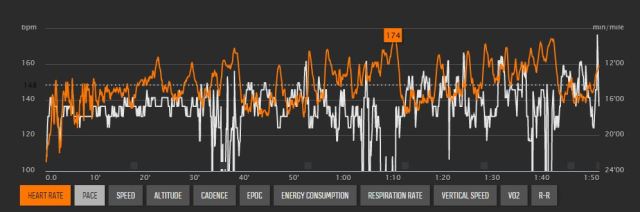
I gave up on keeping my heart rate below 142, and instead tried to keep my heart rate steady. I ended up completely unsuccessful. Spikes all over the place, as you can see in the picture. (Heart rate is shown with the orange line, pace with the white line.)

HRvsPace

Some of the spikes coincide with hills (corresponding to big drop-offs in pace), but not all of them. It needs to warm up so I can enjoy running outside. Today is treadmill city, again (so was yesterday), since it’s the middle of the day and it’s only 1 F. I suppose I should be glad it’s been mild up til now, but there’s still a lot of winter to go.

MAF Test Attempt #1

My replacement heart rate monitor came on Saturday, and after I remembered I needed to sync it before it would connect with my watch, I was able to take it out for a test on Sunday.

I was attempting to set a baseline for measuring my aerobic progress using the MAF Test recommended by Dr. Maffetone. I was supposed to run a warm-up, followed by 5 miles at my maximum aerobic heart rate (mine is 142), and then a cool-down. The warm-up is 15-20 minutes long (or longer) and I was supposed to gradually increase my heart rate to 142. The 5 miles at 142 bpm should have gotten progressively slower, and then I had to cool down for 15-20 mins, bringing my heart rate gradually back down.

That’s not how it worked.

I chose to do the test along Minnesota Ave. on Minnesota Point, because it’s flat, so I wouldn’t have hills messing up my results. It didn’t seem that cold and the trees didn’t seem to be moving so I didn’t think there was any wind. Wind and cold can affect the heart rate. It turned out it was windy, so that was annoying.

I was having trouble with my heart rate from the get-go. I was walking and it was spiking even though I was barely exerting myself, and then the monitor slipped down and I lost contact. It wasn’t tight enough, since I was afraid of stretching out the strap too much, as happened with my first heart rate monitor. Apparently stretching out the strap affects its ability to function. Argh.

Warmup: 1 mile, 18:39, 115 bpm avg

I was micro-managing my heart rate during the first mile, but it was either too high or too low, jumping all over the place. The road was snowy and/or icy in spots, and the sidewalks weren’t consistently cleared. I was running on the road and at times had to pause and wait for cars to go by before I could safely get around parked vehicles. I ended up with almost exactly the opposite of what is supposed to happen in the test.

Mile 1: 16:52, 137 bpm
Mile 2: 16:03, 134 bpm
Mile 3: 16:00, 133 bpm
Mile 4: 15:27, 134 bpm
Mile 5: 15:43, 135 bpm

Whoops. I’m not sure what this means. Maybe I need a longer warm-up. Maybe I need to use a lower max heart rate. Maybe this is not going to work in winter. I don’t know.

Cooldown: 0.74 mi, 19:06 pace, 122 bpm avg

I’m going to give the test another try in a month or so and see if I can get a better result. The workout itself was good, I felt great afterward, and the warm-up and cool-down felt nice. So it wasn’t a total loss, although it was frustrating trying to make the test work.

I looked at the extended forecast and it looks like there’s only a week or so of the somewhat unusually warm weather left, so that was a bit depressing. I also signed up for the lottery for the Superior 25K in May, so with a little luck, I’ll get in.

Year Two

Here’s to a year of running seriously!

I rang in the new year this year by “summitting” Ely’s Peak. It was unpleasant. I was in knee-deep snow at times. I only “ran” 2.3 miles. I can’t say that there was more than a half a mile of that that I’d consider actual running, sans quotation marks. It took an hour.

2015 was a pretty good year for running (for me): I ran 1193 miles, completed 6 races and volunteered at another, and lost 20 lbs. It was a good start.

In 2016, I want to be a bolder, braver runner. I have goals to that effect. My must-achieve goals are:

  • Become an ultramarathoner (at the Wild Duluth 50k)
  • Get “redemption” at the Park Point 5 Miler (by running much faster)
  • Be more social (by meeting other runners, joining UMTR, participating the NMTC races this summer, and volunteering)

I have some stretch goals, too.

  • Run a 5k under 30 minutes
  • Complete a whole cycle of aerobic/MAF training
  • Eat better

Some are more achievable than others, obviously. I have to eat better, but I am not sure if I can develop overall “better” eating habits in a year. I’m not even sure what that means. I do have to figure some stuff out, food-wise, before the fall. Otherwise completing 50k is going to be rough. Well, it’ll be rough anyway, but I need to be as prepared as possible.

I don’t know if the 5k goal is possible but I also don’t care, I am going to try.

I have three goal races. I’ve had these tentatively planned as goal races for awhile, but I wasn’t sure if I was staying in Duluth or not. The goal races are:

I plan on running other races, of course, but I will be following specific training plans for those three. If I don’t get in to the Superior 25K, I’ll make the Zumbro 17 my spring goal race, as I am already signed up.

These are all big dreams and nothing more at the moment, but I’m already working to lay the foundation for success this coming year. I hope to stay injury-free, motivated, and happy!

Review: The Big Book of Endurance Racing and Training

Over the past week, I read Dr. Phil Maffetone’s book, The Big Book of Endurance Racing and Training. I’ve kind of tried doing MAF/heart rate training in the past, but in a half-cocked manner. After finishing the book (well, most of it), I can’t say that I’m going to change too much about my approach, but I have some new things to consider.

TL;DR review: Training section good, nutrition section iffy.

There were whole sections of the book that I skipped for now, but will refer to when they become more relevant. I skipped the racing part because I won’t be racing until April. I skipped the injury part because I’m not currently injured, knock on wood. I looked askance at some of the pain and injury suggestions. I can’t just take it on faith that cleaning up my diet will reduce injury. You better believe when I have menstrual cramps, I’ll be reaching for the NSAIDs, Dr. Maffetone.

I had to laugh when he shared some anecdotes from runners who couldn’t believe they had to run so slow under his guidance. OMG an 8 min pace! So slow! Like crawling on hands and knees! How horrible for these poor people. I suppose part of the reason this training appeals to me is because I’m already slow.

I definitely wanted to run right out and do the MAF test to get started! The MAF test involves a very specific warm-up, followed by a 5 mile run at max aerobic heart rate (mine is 142), and then a specific cool-down. The paces for each mile should slow with each progressive mile, and over time, the overall paces should increase as aerobic fitness improves. I wasn’t sure how this was going to work for me, since Duluth is so hilly, but I can do the test on Park Point. Then I remembered I don’t have a heart rate monitor at the moment (Suunto is sending me a replacement since the first one went kaput about 6 months into use) so the test is on hold.

I’m a little concerned about putting the training into practice in the winter. Dr. Maffetone mentions that weather can impact the heart rate significantly, especially a combination of cold and wind. I live in Duluth, and it’s winter. It’s cold and windy. I know last winter I tried and kind of gave up, because I was having a tough time staying warm. I’m going to give it another shot, but I might also have to give it a rest until spring.

I found the training aspects of the book very helpful. The gist of it is online and available for free, but I appreciate the depth of the book, as well as the readiness of the information. I don’t want to click around a bunch of articles and blog posts to find the information piecemeal.

While I’m sold on the training aspects of the book, I’m on the fence about the nutritional aspects. I know I need to make changes to my diet to improve my overall health. I am not sure I am willing to make the changes suggested in the book.

The book clearly was not written for someone like me, i.e. someone who is overweight and actively trying to lose weight. It’s more addressed to someone who is already at a decent weight. Or, at least, that’s what it seemed. I really can’t stand when people say counting calories doesn’t work. I believe counting calories is a necessary step for most people who are trying to lose weight. Counting calories without making any other changes in lifestyle, diet, or attitude is what does not work, at least in my opinion. Counting calories was an eye-opener to me, as far as how much I was actually eating. It’s a useful tool, but I am not slavish to it, I’m not trying to eat as few calories as possible, and it’s not the only thing I’m doing to try to lose weight.

I’m just not interested in giving up carbohydrates entirely. I’m not even ready to give them up for the duration of the “Two Week Test,” which determines carbohydrate intolerance. Which is… ugh, that term. It just seems so silly. If I’m eating too much sugar or too many refined carbs, I’m eating too much junk. That doesn’t mean I should never eat rice or beans again because I’m “intolerant” of carbohydrates. I probably experience more “symptoms” from leafy greens, which Dr. Maffetone sings the praises of, than I do from a baguette.

Part of me is tempted to do the two-week test because apparently weight just drops off people magically despite not counting calories (and possibly increasing caloric intake) because of the awesome powers of fat burning. Apparently he’s seen people drop 20 pounds in 2 weeks! Which isn’t unhealthy at all!

I will probably have to do some additional reviews of certain sections of the book as they become applicable. I was planning to transition to a more minimal shoe with my next shoe purchase, and I will use the racing, MAF test, and nutrition sections as they become relevant or as I make changes to training and nutrition. I am glad to have read the book, but some aspects seem a bit extreme for me, especially since I’m not an elite, overly-dedicated runner, and because I like to eat dessert sometimes.